
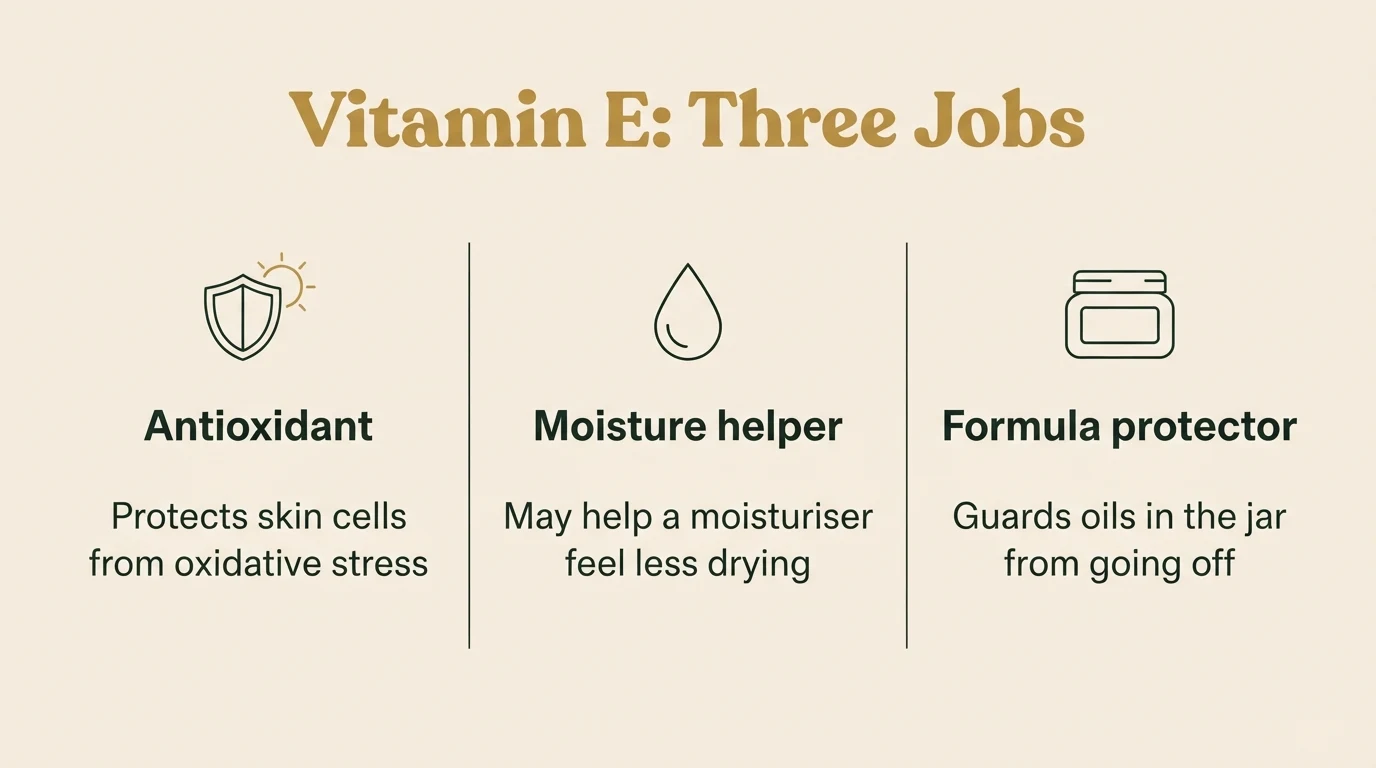
Mostly, it works as an antioxidant — protecting skin cells and protecting the oils in the jar itself from going off. A Cleveland Clinic dermatologist calls the skin benefit real but fairly subtle: it may help a moisturiser feel less drying, but it does not treat any skin condition and it cannot replace sunscreen.
- Main job
- Works as an antioxidant, both for your skin and for the oils inside a balm or cream.
- Moisture effect
- Described by dermatologists as modest — it may help a moisturiser feel less drying, most noticeable on already-dry skin.
- Medical claims
- None exist for vitamin E in skincare, and Aloe Yami never makes one.
- Sun protection
- Absorbs a little UVB but none of the UVA that causes sunburn, so it is never a sunscreen substitute.
- In Aloe Yami Balm
- Listed on the label as vitamin E extract, one of three ingredients, alongside petroleum jelly and aloe vera extract.
- Checked
- Against a Cleveland Clinic dermatologist's review and a cosmetic-formulation reference, both opened October 2026.
What does vitamin E actually do for skin?
Mainly, it works as an antioxidant. That means it helps protect skin cells from the ordinary wear of being out in the sun and the air, a process dermatologists call oxidative stress. Cleveland Clinic dermatologist Dr Amy Kassouf puts it plainly: vitamin E “acts as an antioxidant, helping protect cells from damage.” It occurs naturally in your skin’s own oil, and levels fall with age and sun exposure.
It also probably helps moisturisers work a little better. Dr Kassouf’s own description is careful rather than enthusiastic: in most studies, “it’s unclear… if it has a direct medicinal role,” and its effect on skin is “fairly subtle.” The benefit is mainly softening and reduced dryness, most noticeable if your skin is already dry — oily, acne-prone skin already gets plenty of its own.
Does vitamin E treat any skin condition?
No — and a dermatologist says so in those exact words. Dr Kassouf states that vitamin E “doesn’t treat any particular skin condition.” Its only established use is general, modest support for ordinary ageing and dryness, not a fix for a diagnosed condition such as eczema, psoriasis or acne.
That is also why Aloe Yami Balm, which lists vitamin E extract as one of its three ingredients, is sold and described only as a cosmetic. It is meant to moisturise and comfort skin — never to diagnose, treat, cure or prevent anything.
Can vitamin E replace sunscreen?
No. Vitamin E may absorb some UVB light and ease some of the inflammation that comes with it, but Cleveland Clinic’s review notes the evidence there “isn’t clear-cut yet,” and vitamin E does not cover UVA, the wavelength most linked to sunburn and skin cancer. The advice is direct: “don’t replace your sunscreen with vitamin E oil.” Studies cited in the same review found vitamin E does not prevent or treat skin cancers either.
Why do skincare formulas add vitamin E to the oils themselves?
Because oils and fats oxidise and turn rancid over time, changing colour, smell and texture. A cosmetic-ingredient reference describes alpha-tocopherol (vitamin E) as a chain-breaking antioxidant that traps the free radicals responsible for that breakdown, which is why it is used in products with an oil-rich phase, typically at 0.1–1%.
This is a different job to the one it does on your skin. One is a skincare benefit, modest and still debated. The other is a formulation choice, well-established in cosmetic science: it keeps the product itself in good condition on the shelf, not just your skin after you apply it.
| Role | What it does | How solid is the evidence |
|---|---|---|
| For your skin | Antioxidant; may help a moisturiser feel less drying | Real but modest, per Cleveland Clinic |
| For sun exposure | Absorbs some UVB, not UVA; never a sunscreen substitute | “Isn’t clear-cut yet” |
| For the jar itself | Protects oils like petroleum jelly from oxidising and turning rancid | Well-established in formulation |
Vitamin E is an antioxidant here, and nothing more is claimed. Nobody selling the balm should say it treats, cures or heals a skin condition, or call it clinically proven or dermatologist-tested — none of that has been established for this product.
Why is vitamin E in Aloe Yami Balm specifically?
It is one of three ingredients printed on the jar, alongside petroleum jelly and aloe vera extract — the full breakdown is in our guide to what's in Aloe Yami Balm. The product page calls it “the keeper”: an antioxidant that looks after the balm itself, so a sealed 50 ml jar keeps its condition while you use it or sell through a pack.
Petroleum jelly does the heavy lifting of holding moisture in, and aloe vera extract is the part that goes on cool — see our guide on whether aloe vera is good for dry skin for that side of the jar. Vitamin E’s job is quieter: it is there for the formula as much as for your face.
Should you patch test a product with vitamin E in it?
It is sensible with any new product, vitamin E or not. Put a small amount on the inner arm, wait 24 hours, and stop straight away if there is any irritation or discomfort. The full safety label for Aloe Yami Balm — external use only, avoid the eyes, keep from children — is set out on the product page.
Where this page describes vitamin E in general, the source is named and was opened this month. Where it describes Aloe Yami Balm specifically, it is quoting the label and the product page — not a study of this product. There is no such study.
- Vitamin E's main job is as an antioxidant, for skin cells and for the oils in a formula.
- Its moisturising effect is real but modest — "fairly subtle," per a Cleveland Clinic dermatologist.
- It does not treat any skin condition, and it cannot replace sunscreen.
- In a formula, it mainly protects oils like petroleum jelly from going rancid.
- In Aloe Yami Balm, it is one of three labelled ingredients — "the keeper" of the jar.
Common questions
What does vitamin E actually do for skin?
Mainly, it works as an antioxidant, helping protect skin cells from everyday oxidative stress. Cleveland Clinic dermatologist Dr Amy Kassouf says it also probably helps moisturisers work a little better, though she describes the effect as fairly subtle rather than dramatic.
Does vitamin E treat eczema, acne or any other skin condition?
No. Dr Kassouf states plainly that vitamin E doesn't treat any particular skin condition. Its only modest, general benefit is for ordinary ageing and dryness, not a diagnosed condition, which is why a cosmetic containing it is never described as treating, curing or healing one.
Can vitamin E replace sunscreen?
No. It may absorb a little UVB light, but it does not protect against UVA, which is what causes sunburn and contributes to skin cancer. Cleveland Clinic's advice is direct: do not replace sunscreen with vitamin E oil.
Why is vitamin E added to the oils in a skincare formula, not just rubbed on skin?
Because oils and fats oxidise and turn rancid over time. Tocopherol (vitamin E) is used as an antioxidant to protect the oil-rich part of a formula, typically at 0.1 to 1 percent, so the product itself keeps its condition in the jar.
Why is vitamin E in Aloe Yami Balm?
It is one of three ingredients on the label, alongside petroleum jelly and aloe vera extract. The product page describes it as the keeper: an antioxidant that looks after the balm itself, so a sealed jar keeps its condition while a pack is sold through.
Is vitamin E in skincare clinically proven?
Not in the way that phrase implies. No study on this page is about Aloe Yami Balm specifically, and no claim here says vitamin E is clinically proven, dermatologist-tested or hypoallergenic, because none of that has been established for this product.
Want the rest of the label? Our guide to what's in Aloe Yami Balm covers all three ingredients, or see the full list and safety information on the product page. Still have a question? The help page answers the common ones, or send us a WhatsApp.
Read the whole label
The ingredient list, how to use the balm and the safety label are all on the product page, in the order customers ask about them.