Yes, but only for part of the job. Aloe vera is a humectant — it draws moisture into the skin and soothes on contact — but it has only a mild occlusive effect, so it does not lock that moisture in on its own. For genuinely dry skin, it works best paired with something heavier, like an oil or a balm, applied straight after.
- What aloe vera does
- Draws moisture into the skin — it is a humectant.
- What it does not do alone
- Reliably lock that moisture in — its occlusive effect is mild, not strong.
- Best paired with
- An oil, cream or balm, applied while skin is still slightly damp.
- The overuse caveat
- Its natural enzymes can act as a mild exfoliant in large amounts.
- In Aloe Yami Balm specifically
- Aloe vera extract is combined with petroleum jelly and vitamin E in one formulation.
What does aloe vera actually do for skin?
It draws water in. Aloe vera gel contains polysaccharides — long sugar-chain molecules — that act as a humectant, pulling moisture from the air and from deeper skin layers up into the surface. That is a real, useful effect, and it is why aloe vera feels cooling and hydrating the moment it goes on.
What it is not especially good at is the second half of moisturising: keeping that water from evaporating straight back out again.
Can aloe vera alone keep skin from drying out?
Not reliably on its own. Skincare sources describe aloe's polysaccharides as forming "a thin, moisture-retaining film that functions as both a humectant... and a mild occlusive" — mild being the operative word. One skincare brand's own consumer guide puts it plainly: layer aloe products under a richer moisturiser to actually seal the benefit in, rather than relying on aloe by itself.
Picture a bucket with a small hole in it. Aloe vera keeps pouring water in — that part works. An occlusive is what plugs the hole.
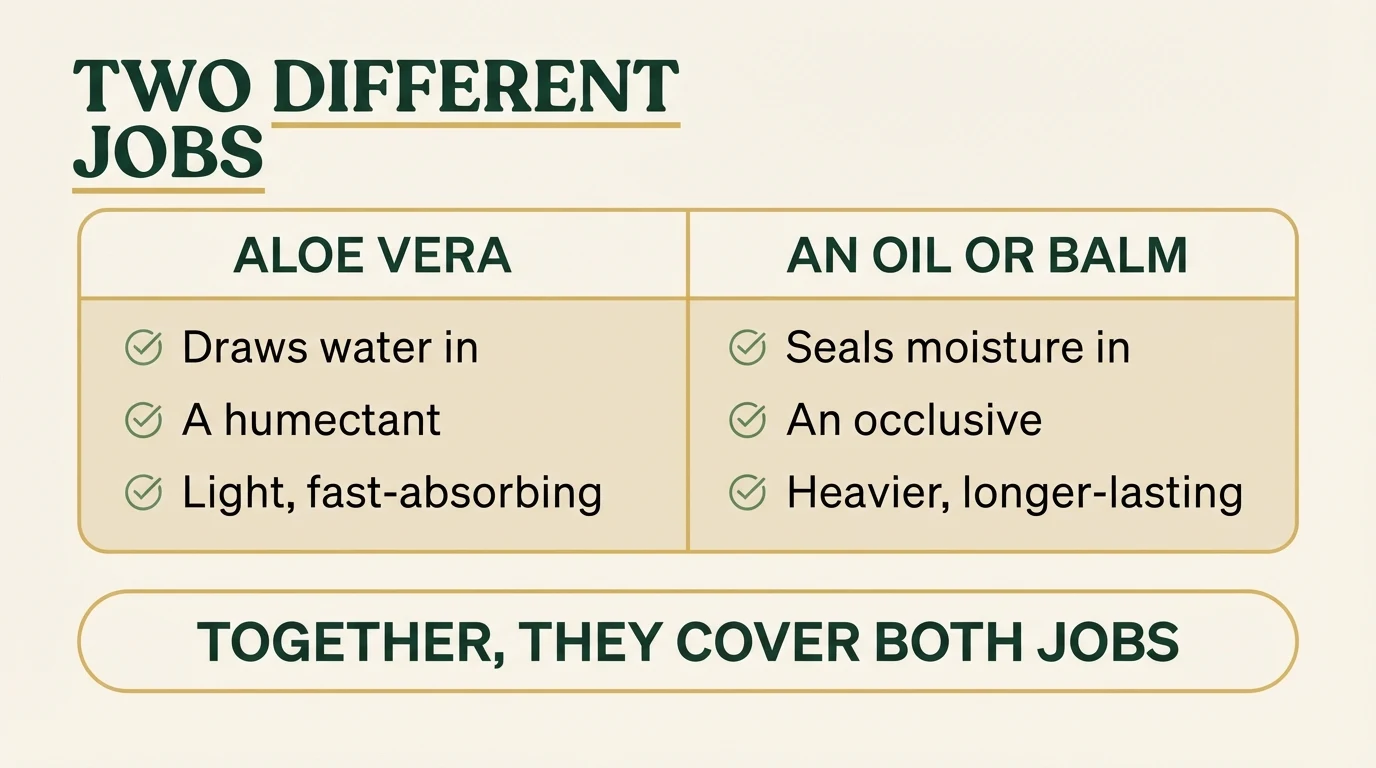
Humectant vs occlusive: what is the actual difference?
Two different jobs, and dry skin needs both done.
| Job | Humectant (aloe vera) | Occlusive (an oil or balm) |
|---|---|---|
| What it does | Draws water into skin | Seals water into skin |
| Feel | Light, fast-absorbing | Heavier, sits on top |
| Best used | First, on slightly damp skin | Straight after, to lock it in |
So what should you actually put on dry skin?
Aloe vera first, while skin is still slightly damp — from a shower, or a light water mist — then something heavier straight after, before the moisture aloe drew in has a chance to evaporate.
A formulated barrier balm that already combines a humectant and an occlusive does this in one step instead of two. That is the logic behind pairing aloe vera extract with petroleum jelly, which is why Aloe Yami Balm combines both, alongside vitamin E, rather than being aloe vera on its own.
This is general skincare information, not a claim about what any specific product cures or treats. If a skin concern persists, it is worth a pharmacist or dermatologist's opinion rather than guessing.
Is there such a thing as too much aloe vera?
In theory, yes. Aloe vera contains natural enzymes that can act as a mild exfoliant, and some skincare sources note that applying it too often, or in place of a proper moisturiser entirely, can leave skin feeling drier rather than better hydrated over time.
A thin layer, followed by something to seal it in, is the more reliable approach than reapplying aloe vera repeatedly on its own and expecting it to do both jobs.
Is Aloe Yami Balm the same as pure aloe vera gel?
No — and that is a genuine difference, not a marketing one. Pure aloe vera gel is mostly the humectant on its own. Aloe Yami Balm is a formulated 50 ml balm that combines aloe vera extract with petroleum jelly and vitamin E extract, for face, body and scalp — the humectant and the occlusive in one jar, rather than two separate products you have to layer yourself.
- Aloe vera is a humectant — it draws moisture into skin, and that part genuinely works.
- Its occlusive effect is mild, so it does not reliably lock that moisture in on its own.
- Pair it with an oil, cream or balm applied while skin is still slightly damp.
- A formulated balm that already combines both saves the two-step layering.
- This page describes what aloe vera does generally — it is not a medical claim about any product.
Common questions
Is aloe vera good for dry skin?
Yes, but only for part of the job. Aloe vera is a humectant, which means it draws moisture into the skin and soothes on contact. It is not a strong occlusive, so it does not lock that moisture in on its own. For genuinely dry skin, it works best paired with something heavier applied straight after.
Does aloe vera moisturise skin on its own?
Partly. It hydrates by drawing water into the upper layer of skin, which is real and useful, but on its own the water it draws in can evaporate again within a short time. Skincare sources describe it as having only a mild occlusive effect, not a strong sealing one.
What should you put on skin after using aloe vera?
Something heavier, applied while the skin is still slightly damp from the aloe vera. An oil, a cream, or a barrier balm all work, because their job is exactly the one aloe vera does not do well: sealing moisture in rather than drawing it in.
Can you use too much aloe vera on your skin?
Yes, in theory. Aloe vera contains enzymes that can act as mild exfoliants, and some skincare sources note that overusing it may leave skin feeling drier rather than better moisturised. A thin layer, followed by something heavier, is the more reliable approach than applying it repeatedly on its own.
What is the difference between a humectant and an occlusive?
A humectant, like aloe vera, draws water into the skin from the air and from deeper layers. An occlusive, like petroleum jelly or a heavier oil, sits on top of skin and physically slows moisture from evaporating back out. Dry skin usually needs both jobs done, not just one.
Is Aloe Yami Balm the same as pure aloe vera gel?
No. Aloe Yami Balm combines aloe vera extract with petroleum jelly and vitamin E extract in one formulation, so the humectant and the occlusive are applied together in a single step rather than as two separate products.
See the actual formulation
Aloe Yami Balm combines aloe vera extract, petroleum jelly and vitamin E in one 50 ml jar — the full ingredient list and how to use it is on the product page.