
It depends on how many jars you sell, and nobody can know that for you. The fixed part is the sum per jar: you pay R85 to R95, the Army suggests R128 to R143, so R43 to R48 a jar is yours. At the suggested price you break even after selling roughly three-quarters of a pack.
- The fixed part
- You keep R43 to R48 a jar at the suggested price, depending on the pack.
- The unknown part
- How many jars you sell. Nobody can promise it, including us.
- Break-even
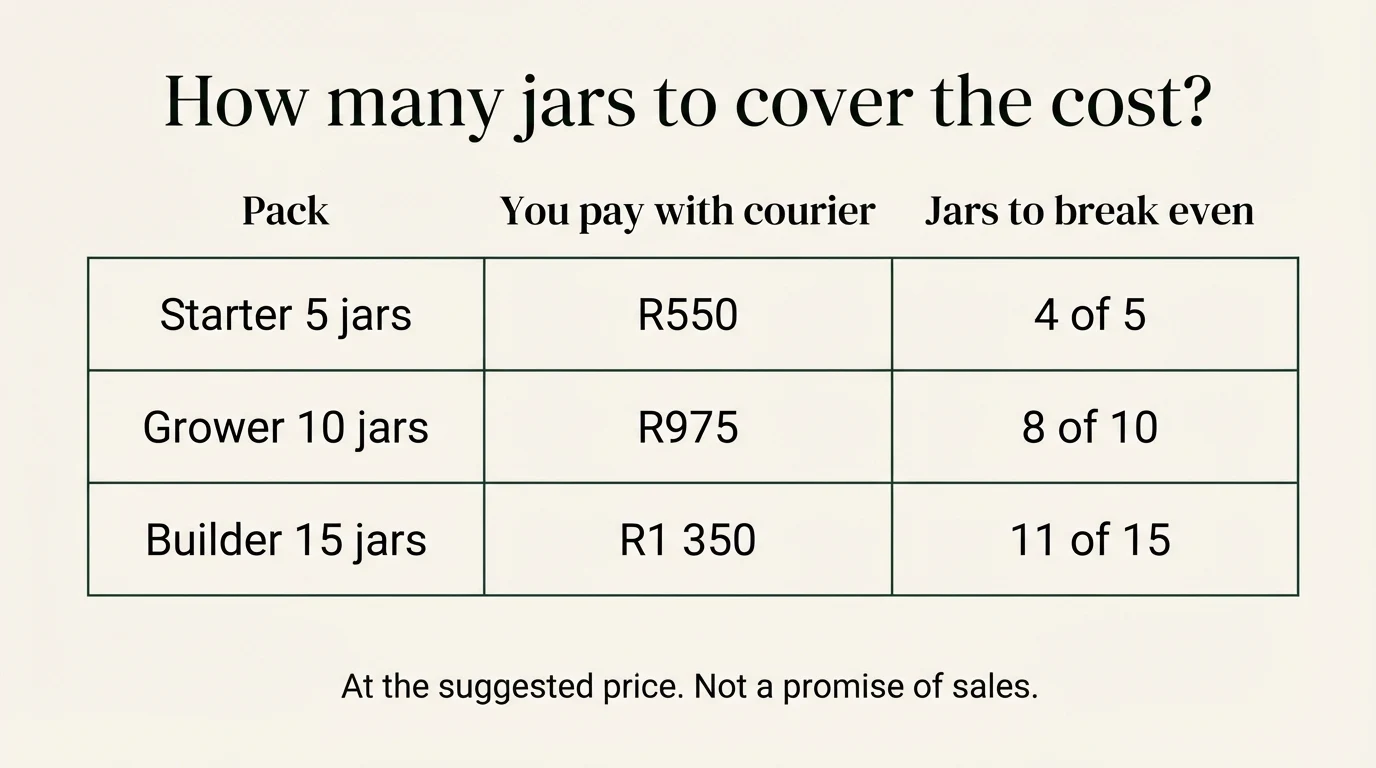
- At the suggested price, 4 of 5, 8 of 10 or 11 of 15 jars cover the pack and courier.
- Courier
- R75 per order, free from 20 jars (as of October 2026).
- Where the money comes from
- Only the difference on jars you sell. There is no other source of income.
What does a pack cost, and what is left if every jar sells?
Start with the best case, because it is the ceiling, not the forecast. Aloe Yami Balm is a 50 ml jar. The Army suggests you add 50% to what you paid. If every jar in a pack sells at that price, this is the difference (as of October 2026).
| Pack | You pay | Sell each at | Takings | Difference | After R75 courier |
|---|---|---|---|---|---|
| Starter, 5 jars | R475 | R143 | R715 | R240 | R165 |
| Grower, 10 jars | R900 | R135 | R1 350 | R450 | R375 |
| Builder, 15 jars | R1 275 | R128 | R1 920 | R645 | R570 |
Those figures assume every jar sells. That is the part this page cannot know. It also leaves out your own costs, such as airtime, transport and your time, which only you can count.
How many jars do you need to sell to break even?
At the suggested price, about three-quarters of a pack. Break-even here means the takings cover the pack price plus the R75 courier. Every jar after that point is difference you keep.
Hold the unsold jars in mind. If you sell fewer, the rest are still yours, with nothing to send back and no deadline. A slow month means stock on the shelf for longer, not a bill.
What if only about half the jars sell?
Then you have not covered the pack yet, and it helps to see that plainly. The shortfall is stock still waiting to be sold, not money gone, but it is real cash you paid out up front.
| Pack | Jars sold | Takings | Cost with courier | Still to recover | Jars left |
|---|---|---|---|---|---|
| Starter | 3 of 5 | R429 | R550 | R121 | 2 |
| Grower | 5 of 10 | R675 | R975 | R300 | 5 |
| Builder | 8 of 15 | R1 024 | R1 350 | R326 | 7 |
Bigger packs mean a bigger difference per jar, but also more cash tied up before the first sale. If you are unsure how fast you can sell, the smaller pack limits what you have at stake.
Is a 50% markup the same as a 50% margin?
No, and mixing them up is a common way to misjudge a price. Markup is profit as a share of what you paid. Margin is profit as a share of what you sell for. Shopify's guide to the two gives a simple example: profit of $10 on a $40 cost is a 25% markup and a 20% margin.
Applied here, a R95 jar sold at R143 has a 50% markup, but the R48 difference is only about a third of the selling price. Neither figure is wrong. They answer different questions, so check which one a price list is quoting.
What happens at the top of the suggested range?
The Army asks members not to go past cost plus 75%, so nobody undercuts the next street and nobody's customer is overcharged. It is a ceiling, not a target, and a higher price may mean fewer jars sold.
| Pack | Sell each at | Takings | Difference | After R75 courier |
|---|---|---|---|---|
| Starter, 5 jars | R166 | R830 | R355 | R280 |
| Grower, 10 jars | R158 | R1 580 | R680 | R605 |
| Builder, 15 jars | R149 | R2 235 | R960 | R885 |
Is any of it taxed?
Side income is income. It goes on your own tax return, and whether you owe tax depends on your total income from every source, salary included. For the 2027 tax year (1 March 2026 to 28 February 2027), SARS sets the threshold for people under 65 at R99 000. If your selling adds up, speak to SARS or a registered tax practitioner.
Why does it matter where the money comes from?
Because South African law draws a line there. Section 43 of the Consumer Protection Act defines a pyramid scheme as one where participants are paid primarily for recruitment rather than for selling goods or services. The same section excludes buying goods at cost to use in making sales from what counts as "consideration".
The arrangement here is the plain version: buy the pack at our price, sell each jar at yours, keep the difference. There is one margin on one product. Read the guide on telling the difference and check it against the Act yourself, rather than taking our word for it.
What would a first month look like?
Nobody can say, and a page that did would be guessing. A fairer exercise is to take the five names you would sell to first, as in the guide to starting with little money, and ask how many would plausibly buy. That number, not ours, is your forecast.
There is no joining fee, nothing to sign and no monthly minimum. To try your own price, use the calculator. For what is in the jar, see the product page.
- You keep R43 to R48 a jar at the suggested price. How many jars sell is the unknown.
- Break-even is about three-quarters of a pack once courier is counted.
- Unsold jars remain yours; nothing is returned and there is no deadline.
- Markup and margin are different measures; a 50% markup is about a third of the sale price.
- Side income belongs on your own tax return.
Common questions
How much can you make reselling skincare products?
It depends entirely on how many jars you sell, which nobody can know in advance. For Aloe Yami Balm the sum per jar is fixed: you pay R85 to R95 and the Army suggests selling at R128 to R143, so the difference is R43 to R48 a jar. Multiply that by the jars you actually sell, then take off courier.
How many jars do I need to sell to get my money back?
At the suggested price, four of the five Starter jars, eight of the ten Grower jars and eleven of the fifteen Builder jars cover the pack price plus the R75 courier. Anything you sell after that is difference you keep. Jars you have not sold yet are still yours.
Is a 50% markup the same as a 50% profit margin?
No. Markup is profit as a share of what you paid; margin is profit as a share of what you sell for. A jar bought at R95 and sold at R143 has a 50% markup, but the R48 difference is about a third of the selling price.
What happens if I only sell half my jars?
You will not yet have covered the pack price, but the unsold jars are still yours to sell later. Nothing is sent back and there is no deadline. Selling five of a Grower pack's ten jars at the suggested price brings in R675 against a R975 cost with courier, with five jars still on your shelf.
Do I pay tax on what I make reselling?
Side income is income, and it belongs on your own tax return. Whether you owe tax depends on your total income from every source. For the 2027 tax year (1 March 2026 to 28 February 2027), SARS sets the threshold for people under 65 at R99 000.
Is there any other way to earn from Aloe Yami?
No. The only money is the difference between what you pay for a pack and what you sell each jar for. There is no joining fee, and nothing is earned from anyone else's purchases.
Still weighing it up? The help page covers the money, the stock and the arrangement, or send us a WhatsApp.
See the whole price list
Three packs, one price for everyone, and the total in front of you all the way down the order form.