

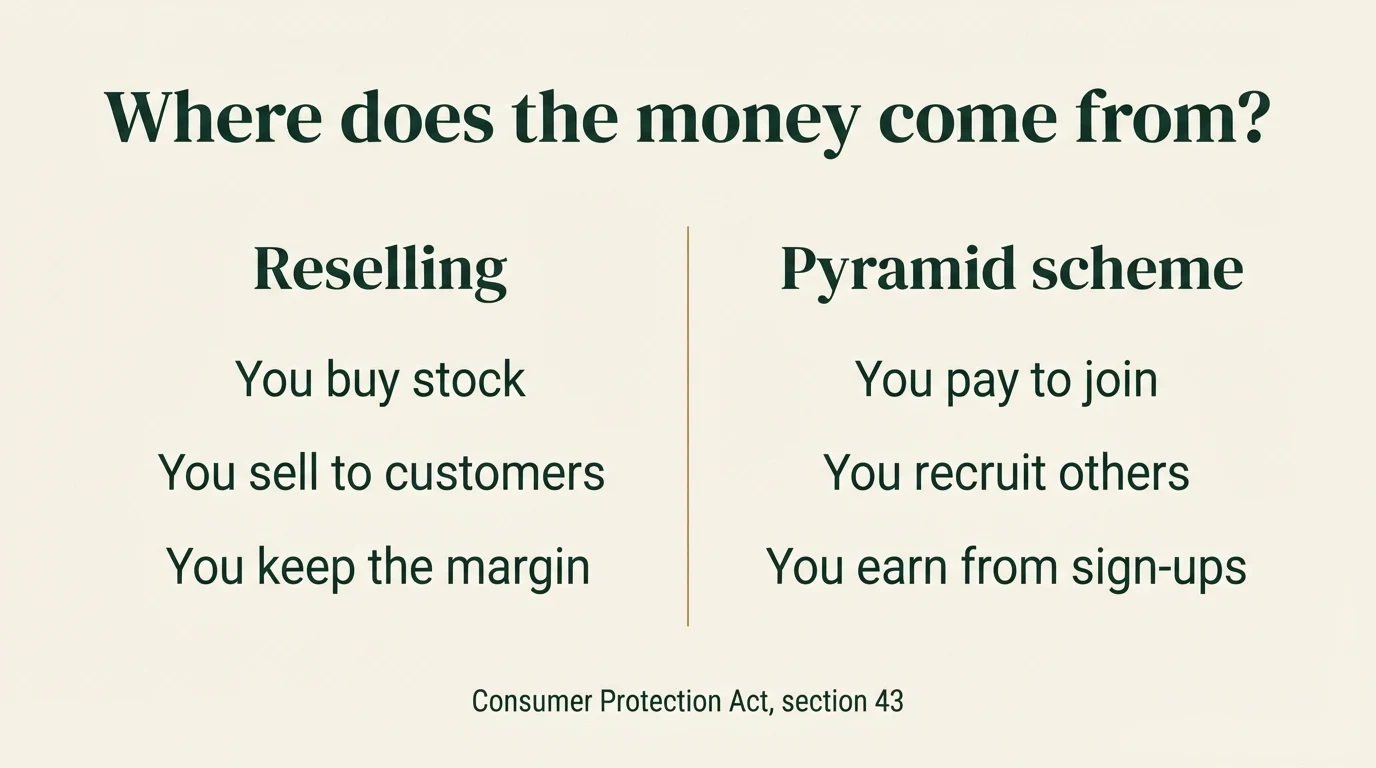
No, not if the money comes from selling. Section 43 of the Consumer Protection Act calls something a pyramid scheme when participants are paid mainly for recruiting other people, rather than for selling goods or services. Buying stock and selling it to customers for more than you paid is ordinary trade. The test is where your money comes from, whatever the scheme calls itself.
- The law
- Section 43 of the Consumer Protection Act 68 of 2008 sets out what a pyramid scheme is.
- The test
- Pay that comes primarily from recruiting people, rather than from selling goods or services, makes it a pyramid scheme.
- The pitch counts too
- A scheme also qualifies if the emphasis in its promotion points to earning from recruitment.
- Who is covered
- The Act says a person must not promote or knowingly join one, so it applies to participants as well as organisers.
- The fine
- The National Consumer Tribunal can impose up to R1 000 000 or 10% of annual turnover, whichever is greater (as of October 2026).
What does the law actually say a pyramid scheme is?
The Act says an arrangement is a pyramid scheme if participants are paid primarily for recruiting other participants, rather than from the sale of any goods or services. That is section 43(4)(a), and it is the heart of it.
There is a second limb. Under section 43(4)(b), it is also a pyramid scheme if the way it is promoted points to that kind of arrangement. So a scheme that sells a product on paper, but pitches the money you will make from bringing people in, can still fall on the wrong side.
Section 43(2) then says a person must not directly or indirectly promote, or knowingly join, enter or participate in, a pyramid scheme, or cause anyone else to. The same section also covers multiplication schemes and chain-letter schemes. You can read the full text in the Act, published by the National Consumer Commission.
So is reselling legal in South Africa?
Yes. Buying goods and selling them on for more than you paid is how every shop works, from a spaza to a supermarket. Nothing in section 43 touches it, because the money comes from a customer buying a product they want.
The Act is specific on one point that matters here. When it works out whether someone paid to join a scheme, it says buying goods at cost to use in making sales does not count. Paying for stock you will sell is not the same as paying a joining fee. Paying for the right to sign people up is a different thing.
How can you check any opportunity against the law?
Ask six questions, in this order. The first two come straight from section 43. The rest are practical checks that tend to show up the same problem from another side. None of them need a lawyer, just the terms in writing and an honest read.
| Ask | A good sign | A warning sign |
|---|---|---|
| 1. Where does the money come from? | Customers buying a product | New people paying to join |
| 2. What does the pitch talk about? | The product and its price | How many people you can bring in |
| 3. Is there a joining or starter fee? | You only pay for stock | A fee that buys you nothing to sell |
| 4. Do you earn from anyone else? | Only from your own sales | A cut of other people's sign-ups or sales |
| 5. Is there a target or contract? | Buy when you want, stop when you want | Monthly minimums or a penalty to leave |
| 6. Is a return promised? | No promise, just the sums | A fixed weekly or monthly payout |
The sixth check has its own rule. Section 43(3) describes a multiplication scheme: one that promises an effective annual interest rate at least 20 percentage points above the Reserve Bank's repo rate. If someone guarantees a return on money you hand over, that is a separate red flag, product or no product.
This is a plain-language reading of section 43, not legal advice. If you are unsure about a specific offer, ask the National Consumer Commission or an attorney before you pay anything.
What happens to people who run or join a pyramid scheme?
Under section 112, the National Consumer Tribunal can impose an administrative fine of up to R1 000 000 or 10% of annual turnover, whichever is greater. It does use it.
In March 2021 the Tribunal fined Up Money R1 million for contravening section 43(2). It had marketed itself as a stokvel, and the Tribunal found participants were paid from recruiting others, with the scheme relying heavily on new people coming in. A friendly name changes nothing; the test is still where the money comes from.
The National Consumer Commission puts the warning sign simply: such a scheme will concentrate on the commission earned for recruiting new members while ignoring the selling of an actual product.
How do we answer the same six checks?
Here are our answers, in the words already on what this is not. Treat them as claims to check, not proof. The point of the six questions is that you can test them yourself against the price list and the Aloe Yami Army terms.
| Check | Our answer | How you can verify it |
|---|---|---|
| 1. Where the money comes from | You are paid for selling balm, not for bringing people in | The only figures on the site are pack prices and jar prices |
| 2. What the pitch is about | A 50 ml jar of balm and what it costs you | Read the home page and the start page |
| 3. Joining fee | None. You pay for jars, and that is all | The order form total is jars plus courier, nothing else |
| 4. Earning from anyone else | Nobody under you, and nobody above you taking a cut | There is no referral code or sign-up link anywhere |
| 5. Target or contract | One 5-jar pack to start, then no reorder obligation and no monthly target | The Army terms and the help page |
| 6. Promised return | None. We show the sum and leave the unknown to you | The calculator runs from 0% to 75% profit and leaves the number of jars to you |
The arrangement is the whole of it: buy the pack at our price, sell each jar at yours, keep the difference. One purchase, one margin. If you tell a friend about the balm and they order their own pack, you earn nothing from that, and neither do we pay anyone for it.
What does that one margin look like in rand?
Each pack has a price per jar. The Army suggests selling at what you paid plus 50%, and asks members not to go past 75%, so nobody undercuts the next street. Courier is R75, free from 20 jars.
| Pack | You pay | Per jar | Suggested sell price | Difference per jar |
|---|---|---|---|---|
| Starter, 5 jars | R475 | R95 | R143 | R48 |
| Grower, 10 jars | R900 | R90 | R135 | R45 |
| Builder, 15 jars | R1 275 | R85 | R128 | R43 |
That difference is the only money in this arrangement. It only exists when a customer pays you for a jar. How many jars sell, and how fast, is the number nobody can fill in for you.
Does passing the test mean a reseller deal is a good idea?
No. Section 43 tells you whether something is legal, not whether it will make you money. A perfectly lawful reselling deal can still leave you with stock nobody wants, or a margin too thin to be worth the effort.
The real risk in ordinary reselling is unsold stock. With us, the jars are yours the day they arrive, with nothing to send back and no deadline. The Army terms are plain that there is no sale-or-return and no buy-back, so the risk of a slow month sits with you. Before you order, run the checks in our guide to starting a side hustle with little money: the real cost per unit, and the first five people you would sell to.
If an offer makes you uncomfortable, report it to the National Consumer Commission on 012 065 1940 or enquiries@thencc.org.za. That goes for any offer, including one that mentions us.
- The Consumer Protection Act draws the line at pay that comes mainly from recruiting, not from selling a product.
- A scheme can fail the test through how it is pitched, even if a product exists.
- Buying stock at cost to sell is not a joining fee in the Act's terms.
- Joining one knowingly is prohibited too, and the Tribunal can fine up to R1 million or 10% of turnover.
- Passing the test makes a deal legal, not profitable. That still depends on what you sell.
Common questions
Is reselling a pyramid scheme?
No. Buying goods and selling them to customers for more than you paid is ordinary trade. Section 43 of the Consumer Protection Act only calls something a pyramid scheme when participants are paid primarily for recruiting other people, rather than from selling goods or services, or when the scheme is promoted that way.
Is it illegal to join a pyramid scheme in South Africa?
Yes. Section 43(2) of the Consumer Protection Act says a person must not directly or indirectly promote, or knowingly join, enter or participate in, a pyramid scheme, or cause anyone else to. The prohibition covers participants as well as the people running it.
What is the penalty for running a pyramid scheme?
The National Consumer Tribunal can impose an administrative fine of up to R1 000 000 or 10% of the respondent's annual turnover, whichever is greater. In March 2021 it fined Up Money R1 million for contravening section 43(2).
Is paying for stock the same as paying a joining fee?
Not under the Act. When section 43 works out whether someone paid to join a scheme, it excludes buying goods at cost to use in making sales. Paying for stock you will sell to customers is different from paying for the right to sign people up.
How do I report a suspected pyramid scheme?
Contact the National Consumer Commission. Its contact centre is on 012 065 1940 and its enquiries address is enquiries@thencc.org.za.
Does Aloe Yami pay me for bringing in other sellers?
No. You are paid for selling balm, not for bringing people in. You buy a pack at our price, sell each jar at yours and keep the difference. If a friend orders their own pack, you earn nothing from it.
Still weighing it up? The help page covers the money, the stock and the arrangement, or send us a WhatsApp. To see what you would keep at a different price, use the calculator.
See the whole price list
Three packs, one price for everyone, and nothing on the order form but jars and courier.