

Nobody can promise any skincare product suits every sensitive skin, and we will not. What we can tell you: the jar holds three ingredients, all printed on the label, and the label says external use only, avoid the eyes, and stop if irritation comes up. If your skin is sensitive, patch test first, twice a day for 7 to 10 days.
- Ingredients
- Three, printed on the jar: petroleum jelly, aloe vera extract and vitamin E extract.
- The label says
- External use only, not for consumption, avoid the eyes, keep out of reach of children, stop if irritation comes up.
- What we do not claim
- The balm is not sold as hypoallergenic, dermatologist-tested or clinically proven, because none of that has been done.
- Patch test
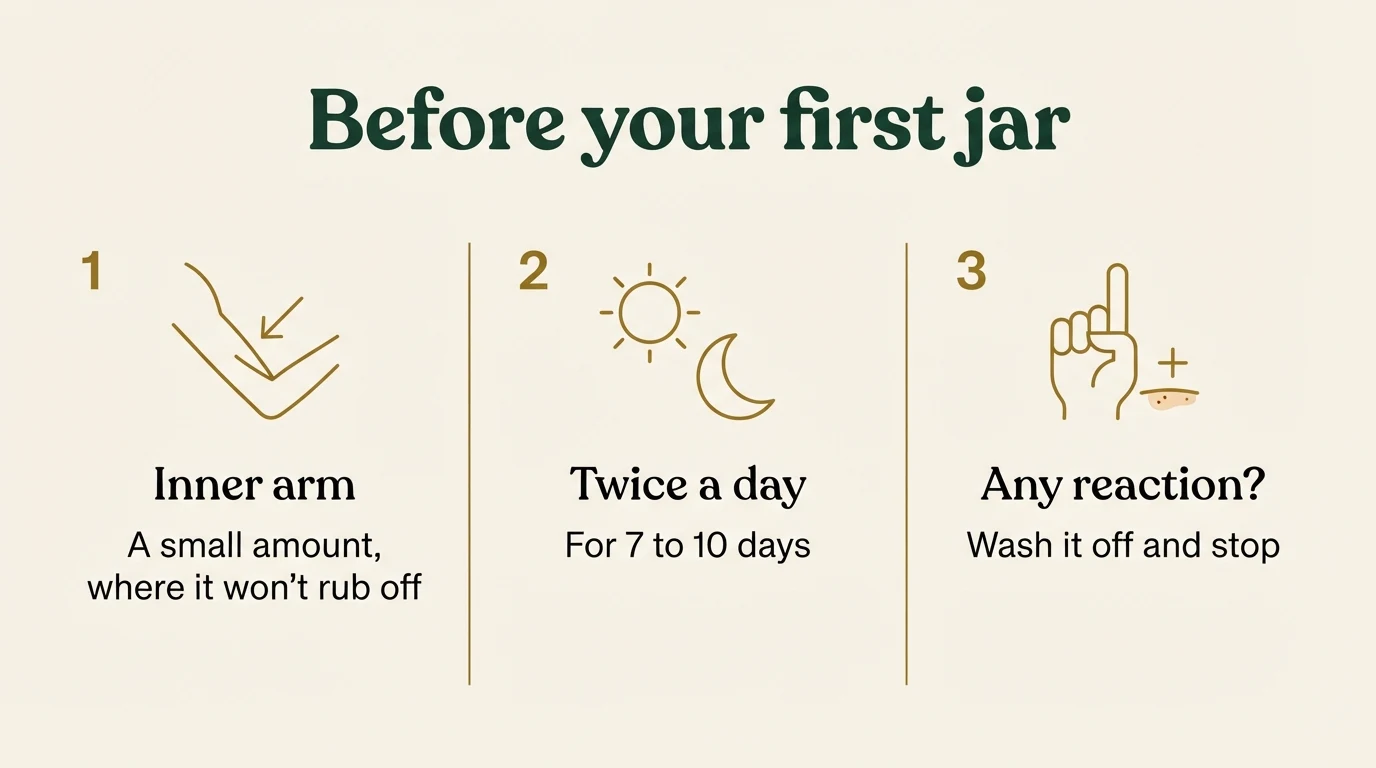
- Inner arm, twice a day for 7 to 10 days, as the American Academy of Dermatology suggests for any new product.
- As of
- The label wording here matches the product page as of October 2026. The printed jar is the final word.
What does the Aloe Yami Balm label actually say?
Six lines, under the heading “Caution, read before use”. They are on the jar and on the product page, not buried in a footer. Here they are word for word, with what each one means day to day.
| The label says | In practice |
|---|---|
| For external use only. | On the outside of the skin. Not inside the nose, mouth or anywhere else inside the body. |
| Not for consumption. | Do not eat it. That includes small children and pets finding an open jar. |
| Avoid direct contact with the eyes. | On the face, keep it off the eyelids and the eye area. If it gets in, rinse with clean water. |
| Keep out of reach of children. | Store the jar where small hands cannot open it, like any other cosmetic. |
| If any irritation or discomfort comes up while using it, stop straight away. | Stinging, itching, redness or swelling means stop. Do not push through it. |
| Store in a cool, dry place. | A cupboard, not a hot car or a sunny windowsill. |
Notice what is not on that list: no promise about sensitive skin either way. That is deliberate. A label can tell you how to use a product safely. It cannot know your skin.
Is Aloe Yami Balm hypoallergenic?
We do not claim it is, and you should be wary of anyone who does. The balm has not been through hypoallergenicity or dermatologist testing, so the word does not appear on the jar or anywhere on this site.
The word itself is weaker than it sounds. The US Food and Drug Administration says there are no federal standards or definitions for “hypoallergenic” on cosmetics, and that the term means whatever a particular company wants it to mean. It adds that dermatologists say it has very little meaning.
Do not tell a customer the balm is hypoallergenic, dermatologist-tested or “safe for all skin types”. None of those is true of this jar. The Product Disclaimer lists the wording you may and may not use.
What is in the jar, and how do those ingredients tend to sit with skin?
Three ingredients: petroleum jelly, aloe vera extract and vitamin E extract. The research below is about each ingredient in general. None of it is a study of this jar, and there is no such study.
Petroleum jelly is the base. A German analysis of 79 365 people patch tested with pure white petrolatum, published in Contact Dermatitis in 2006, found weak allergic reactions in about 0.03% and strong ones in 0.003%. The authors concluded true allergic reactions to it are extremely rare.
Aloe vera is the plant extract. The US National Center for Complementary and Integrative Health says aloe gel on the skin is generally well tolerated, but that there have been occasional reports of burning, itching and rash.
Vitamin E is the third. The Linus Pauling Institute notes that some forms of vitamin E applied to the skin, especially ester forms, have led to skin reactions in some people. The label does not say which form is in the jar, and this page will not guess.
One more thing for sensitive skin: the American Academy of Dermatology suggests fragrance-free products for dry, sensitive skin. Fragrance is not one of the three ingredients printed on the jar. If you need to be certain, read your own jar’s label.
How do you patch test Aloe Yami Balm?
On the inner arm, twice a day, for 7 to 10 days. That is the American Academy of Dermatology’s general advice for any new skincare product, and the product page itself says to patch test before first use.
-
1
Pick a spot that will not rub off
The inner arm or the crook of the elbow. Apply the amount you would normally use, as thick as you would normally put it on.
-
2
Repeat twice a day for 7 to 10 days
Reactions do not always show on day one. Leave the balm on as you normally would, and keep going for the full stretch.
-
3
Watch, then decide
Redness, itching or swelling means wash it off gently and stop. No reaction after 7 to 10 days, and you can use it as normal.
A note on the face: the inner arm is a guide, not a guarantee. Skin on the face can be more delicate. If the arm test passes and you want to use the balm on your face, start with a small area and the pea’s-worth method.
What should you do if your skin reacts?
Wash it off gently and stop using it. That is both what the label says and what the American Academy of Dermatology advises for any product that causes a reaction during a patch test.
A reaction is severe, spreads, or does not settle after you stop. A pharmacist is a good first stop and can tell you whether to see a doctor or dermatologist. A dermatologist can also run proper patch testing to find out which ingredient is the cause.
Who should check with a pharmacist before using it?
Anyone with a diagnosed skin condition, anyone who has reacted to a skincare product before, and anyone thinking of using it on a baby or young child. The label says keep it out of reach of children. It gives no guidance on use for babies, so ask first.
The same goes for broken or damaged skin. The label is about everyday use on healthy skin, and this guide is too.
- No product suits every sensitive skin, and we do not claim this one does.
- The jar lists three ingredients: petroleum jelly, aloe vera extract and vitamin E extract.
- It is not sold as hypoallergenic or dermatologist-tested, and the word means little anyway.
- Patch test on the inner arm, twice a day for 7 to 10 days, before full use.
- Any irritation: wash it off and stop. Severe or lasting: see a pharmacist or doctor.
Common questions
Is Aloe Yami Balm safe for sensitive skin?
Nobody can promise any skincare product suits every sensitive skin, and Aloe Yami does not. The jar lists three ingredients and says external use only, avoid the eyes, and stop if irritation comes up. If your skin is sensitive, patch test on the inner arm twice a day for 7 to 10 days first.
Is Aloe Yami Balm hypoallergenic?
It is not sold as hypoallergenic, dermatologist-tested or clinically proven, because none of that testing has been done. The US Food and Drug Administration also says there is no federal standard for the word hypoallergenic on cosmetics.
What are the ingredients in Aloe Yami Balm?
Three, printed on the jar: petroleum jelly, aloe vera extract and vitamin E extract. Fragrance is not one of them. Your own jar's label is the final word on the list.
How do I patch test Aloe Yami Balm?
Apply your normal amount to the inner arm or the crook of the elbow, twice a day for 7 to 10 days. If you see redness, itching or swelling, wash it off gently and stop. If there is no reaction, you can use it as normal.
What should I do if the balm irritates my skin?
Stop straight away and wash it off gently. That is what the label says. If the reaction is severe, spreads or does not settle, speak to a pharmacist, doctor or dermatologist.
Can I use Aloe Yami Balm on a baby?
The label says keep it out of reach of children and gives no guidance on use for babies or young children. Ask a pharmacist or doctor before using it on a baby.
Want to know what each ingredient does in the jar? Read what is in Aloe Yami Balm. Questions about ordering or delivery are on the help page, or send us a WhatsApp.
The caution list is from the product page. The patch-test steps and fragrance advice are from the American Academy of Dermatology. The “hypoallergenic” point is from the US Food and Drug Administration. The ingredient notes are from Contact Dermatitis (2006), the US National Center for Complementary and Integrative Health and the Linus Pauling Institute. All were checked in October 2026.
Read the whole label
The ingredients, how to use the balm and the full caution list are all on the product page.